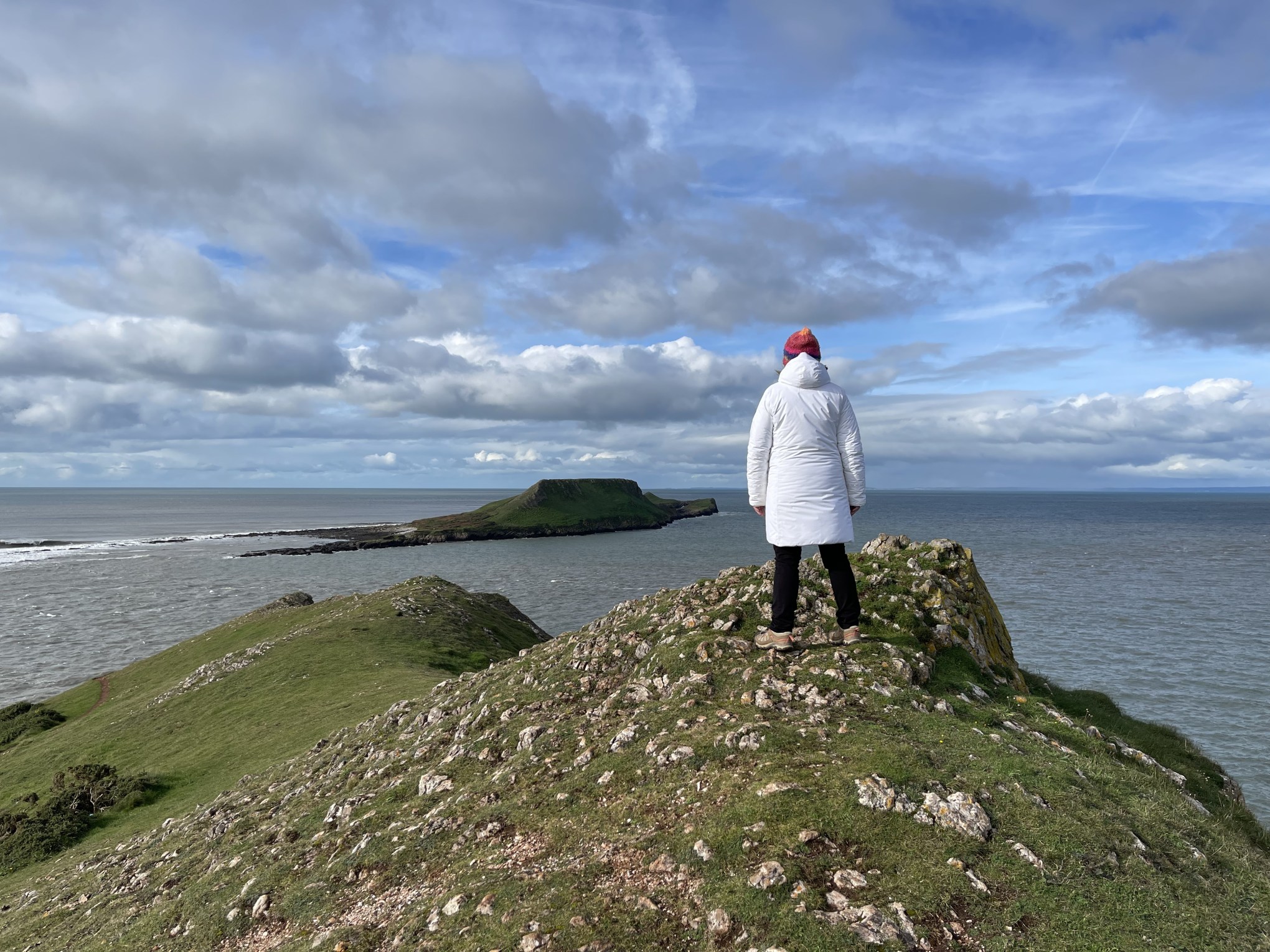
The Worm’s Head is the most westerly point on the Gower, an area of truly outstanding natural beauty. The distinctive Worm’s Head Island is accessible via a stone and sand causeway for a few hours either side of low tide. It lies at the southern end of Rhossili Bay, one of the most beautiful beaches in the British Isles: nearly 3 miles of sand, framed by cliffs and sand dunes. The bay faces directly into the Atlantic and is hugely popular with surfers. The wreck of the Norwegian Helvetia, which ran aground here in 1887, is buried in the sand near the Worm’s Head. Janet and I spent three days exploring the area and gravitated towards this rocky outcrop every day. The walk from Rhossili out onto the headland is quite magical, with semi-wild horses roaming freely on the rich carpet of grass that caps the carboniferous limestone. At the end of the headland, overlooking the rocks that lead onto the causeway, there’s a watch station where eagle-eyed watchmen look out for the safety of those intending to cross over onto the Worm’s Head island. The fierce winds and tides are not to be taken lightly.
Worm’s Head, Gower Peninsula
 This may be of interest ..